Frank Langella etiketine sahip kayıtlar gösteriliyor. Tüm kayıtları göster

12 Şubat 2013 Salı

New Releases On Blu Ray & DVD 2/12/13


The triumphant return to form for 007 that was Sam Mende’s SKYFALL comes out today on Blu ray and DVD. The film, the 23rd in the James Bond series and the 3rd to star Daniel Craig, is available in a deluxe edition (including a DVD and a digital copy) on Blu ray, and a stand alone DVD version. Read my review from its original theatrical release here.


Special features include a couple of commentaries – one with Mendes, the other with producers Barbara Broccoli and Michael G. Wilson and Production Designer Dennis Gassner, a bunch of ‘making of’ featurettes, a segment on the Royal World Premeire of the film at the Royal Albert Hall (you know, with the Queen!), and a promo for the soundtrack.


Stephen Chbosky’s PERKS OF BEING A WALLFLOWER also drops today on Blu ray and DVD. It’s a movie I enjoyed (read my review), but not as much as my wife who adored it, saying that it captured her teenaged high school years beautifully. Both the Blu ray and DVD contain deleted scenes, a few featurettes, and a commentary with Chbosky, who adapted the film from his own young adult novel, and members of the cast including Logan Lerman, Emma Watson, and Ezra Miller. That sounds like a commentary I might want to check out.


Despite the work of a solid cast headed by John Hawkes, who talks in a nasal voice that often sounds like Norm McDonald, I was not a fan of Ben Lewins’ THE SESSIONS, which is now available on Blu ray and DVD. The film, about poet Mark O’Brien who was paralyzed from the neck down, was a hit with audiences, and the Academy as it garnered a Best Supporting Actress nomination for Helen Hunt, but I found it to be too cutesy, especially for its subject matter, and felt that all it had to say was ‘paraplegics need to have sex too.’ Both Blu ray and DVD versions contain deleted scenes and several featurettes.


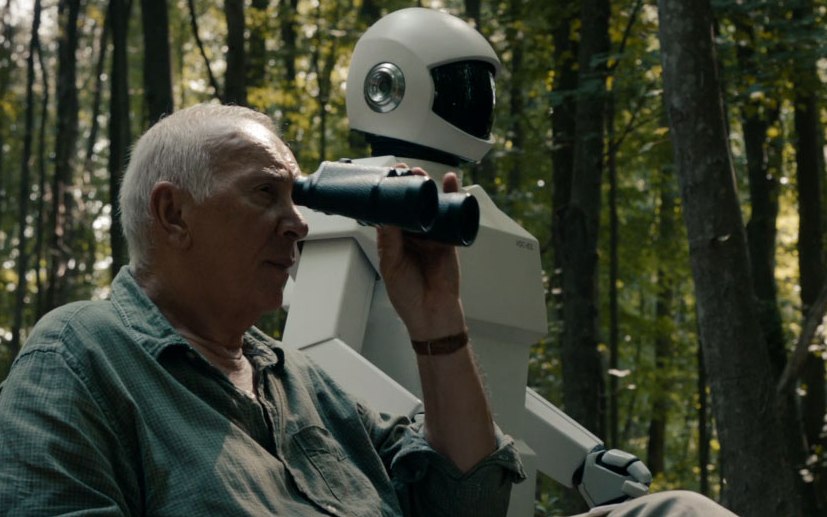
Jake Schreier’s ROBOT & FRANK, also out today but only on DVD, is a movie that I liked a lot better. It’s a silly story, about an aging jewel thief who takes on a helper robot as a partner in crime, but Frank Langella gives it a pleasing gravitas. As I wrote in my review last September, “the charming camaraderie between Frank and his robot (voiced by Peter Sarsgaard) make this a breezily enjoyable 89 minutes.” The only special feature is a commentary with Jake Schreier and Writer Christopher D. Ford.


An acclaimed film that I’m ashamed I haven’t seen yet gets the Criterion Collection treatment today: Jean-Pierre Dardenne and Luc Dardenne’s 2011 drama THE KID WITH A BIKE. The set boasts a new digital transfer supervised by director of photography Alain Marcoen, featurettes including a conversation between film critic Kent Jones and directors Jean-Pierre and Luc Dardenne, interviews with actors Cécile de France and Thomas Doret, a half-hour documentary, “Return to Seraing,” and a booklet featuring an essay by critic Geoff Andrew, but who am I kidding? I’ll be watching it on Netflix Instant where it’ll be available until December 2015 (according to instantwatcher.com). Maybe I’ll like it so much that I’ll want to see the bonus stuff one day. Nice to know the Criterion Collection one is out there in any case.


Finally, a movie I was profoundly disappointed by gets a Blu ray and DVD release: Bill Jones and Jeff Simpson's A LIAR’S AUTOBIOGRAPHY: THE UNTRUE STORY OF MONTY PYTHON’S GRAHAM CHAPMAN. Chapman’s life and comedic legacy aren’t done justice by this misguided adaptation of his autobiography, which he recorded a sort of “book on tape” version of shortly before his death in 1989.


In the faux documentary, those recordings are illustrated by a range of different animation styles, very few of which are appealing, with guest voices by ex-Monty Python members John Cleese, Michael Palin, Terry Gilliam, and Terry Jones, along with Cameron Diaz as Sigmund Freud. Yep. Except for the few instances of actual footage that pops up (“The Spanish Inquisition” sketch, Cleese’s overplayed yet still hilarious eulogy at Chapman’s funeral) it all falls flat. But if you’re a hardcore Python fan that has to see everything, take note: this is also available on Netflix Instant (until Oct. 2017!).


More later...


4 Eylül 2012 Salı

Frankly, My Robot, I Somehow Give A Damn


ROBOT & FRANK (Dir. Jake Schreier, 2012)


“He’s my friend,” Frank Langella says of his robot partner in crime in the new comedy drama ROBOT & FRANK. It’s a simple line, but when quietly spoken by the grand actor, it’s utterly believable, and even a little moving.


Also soft-spoken and convincing is the robot, which looks like it was manufactured by the same company that created EVE from WALL-E, that is, before they could outfit them to fly. This relationship largely works because of the inspired choice of Peter Sarsgaard to voice the never-named robot.

Set in the near future, and mostly taking place in a rickety old house in upstate New York, this film’s premise is cute, even a bit flimsy, but its likability factor is high.

Langella, playing the kind of crusty cranky character he could play in his sleep, is a retired jewel thief, whose son (James Marsden) gives him the robot, and when Frank finds out that his new helper wasn’t programmed to obey the law (and can pick locks in record time), he’s back in the robbery game.

Langella has eyes for the local librarian (a fine but flightier than usual Susan Sarandon), who is dealing with the re-structuring, or re-imaging of her workplace into some kind of new-fangled interactive “library experience” by a group of snobby young rich hipsters headed by Jeremy Strong.

Strong is the target of Frank’s latest sting, but conflict arrives in the form of Liv Tyler as Frank’s hippy daughter who is a part of the anti-robot “human movement.” Although the film’s tagline is “Friendship doesn’t have an off switch,” Tyler has a password that de-activates the robot, and this makes for one of the weakest and least thought out sequences in the film. Frank never thinks to call Marsden for the password, and the way the situation is resolved is really lazy writing.

That doesn’t ruin the film though, not even the shoe-horned in detective character (Jeremy Sisto) on the trail can do that, as the charming camaraderie between Frank and his robot make this a breezily enjoyable 89 minutes at the movies.

Director Schreier, who was the keyboardist for the indie band Francis and the Lights who provide the film’s soundtrack, shuffles pleasantly through the screenplay by Christopher D. Ford, and it’s a promising full-length film debut for both of them.

Even in such a light movie, Langella is a heavy presence. ROBOT & FRANK is capable enough to both capture his poignant power and hold our attention.

More later...

26 Eylül 2010 Pazar

WALL STREET: MONEY NEVER SLEEPS: The Film Babble Blog Review

WALL STREET: MONEY NEVER SLEEPS

(Dir. Oliver Stone, 2010)

Spoiler Alert!: This review gives away a number of key plot points because, well, I just don’t care.

Last year I wrote that a sequel to Oliver Stone’s seminal 1987 WALL STREET was one of 10 sequels to classic movies that should not happen. Despite that I had a tiny sliver of hope inside that the controversial director might pull off another timely indictment of America’s financial system.

Sadly, the return of Gordon Gekko to the silver screen is no such film. It’s as unnecessary a retread as BLUES BROTHERS 2000, which incidentally also began with the prison release of a major character.

In 2002, Michael Douglas as Gekko, 67 years old with his lion's mane of hair now gray, walks out of Sing Sing Maximum Security Prison after serving 8 years to find nobody waiting for him. The camera circles his head to let this sink in.

The film flashes forward to 2008 and for a while it’s Shia LaBeouf’s movie. LaBeouf is an ambitious trader – think Charlie Sheen in the first film but with more ethics – engaged to Douglas’ activist blogger daughter (Carey Mulligan).

LaBeouf’s mentor (Frank Langella) at his firm commits suicide after rampant rumors cause the company’s stock to crash.

Josh Brolin, as an old school Gekko-ish hedge fund manager, is suspected by LaBeouf as being the source of the rumors. Going behind Mulligan’s back, LaBeouf consults with Douglas who wants to be close to his daughter again.

Mulligan wants nothing to do with her father. She blames him for the overdose death of her brother and she’s vehemently against the Wall Street world which makes it hard to believe that she’s surprised to find out that her fiancé is a “Wall Street guy”.

LaBeouf wants to avenge Langella, make a name for himself, and sincerely help a renewable fusion-energy company run by the always nice to see Austin Pendleton – in the same manner that Sheen wanted to help out his father’s ailing airline.

Upon learning that Douglas set his daughter up with a Swiss trust fund worth $100 million, LaBeouf finds himself caught in a web of convoluted double crossings.

Stone uses every visual trick up his sleeve to shape this material – at a point in one of several flashy montages full of split screens, tangled neon cable news ticker tape, and computer animation I felt like I was trapped in a MSNBC hall of mirrors.

The problem is that what made the first movie great is that Gordon Gekko was not a redeemable character. He was a symbol of corporate evil and a necessary one, for there are horrible fiscal creatures out there that destroy thousands of people’s lives with no remorse.

If Gekko truly isn’t a sociopath (as his daughter calls him early on), but a visionary that predicts the economic collapse in 2008 and can be won over by a disc containing his future grandson’s ultrasound – what does he symbolize now?

Douglas’s Oscar winning performance of Gekko in the first film was named by AFI as number 24 of the top 50 movie villains of all time in 2003. After his defanged depiction here that number will surely drop next time they update the list.

It’s understandable that Stone and Douglas wanted to revisit this terrain, but with its predictable plot and pat happy ending this is more than a missed opportunity – it’s a failed follow-up of epic proportions.

One of the only enjoyable elements is the soundtrack provided by David Byrne and Brian Eno. As the first film ended with the Talking Heads’ “This Must Be the Place (Naive Melody)”, this one obviously tries to match the mood with a fine selection of the duo’s collaborations. When these melodies appear it’s the only time that this film feels anywhere near the league of the original.

Beyond that, WALL STREET: MONEY NEVER SLEEPS (awful title) has little point to it, except maybe to unleash a bunch of new Gekko-isms on the public.

Of the many so called pearls of wisdom the slick slimy Gekko spouts - “Idealism kills every deal” – sticks out. By sparing us the true cutthroat nature of the beast in favor of trite sentimentality, the deal is definitely dead as a doornail here.

More later...